
The Economic Crossover
Every machine on your yard has a moment when it stops making you money. Almost nobody catches it on time.
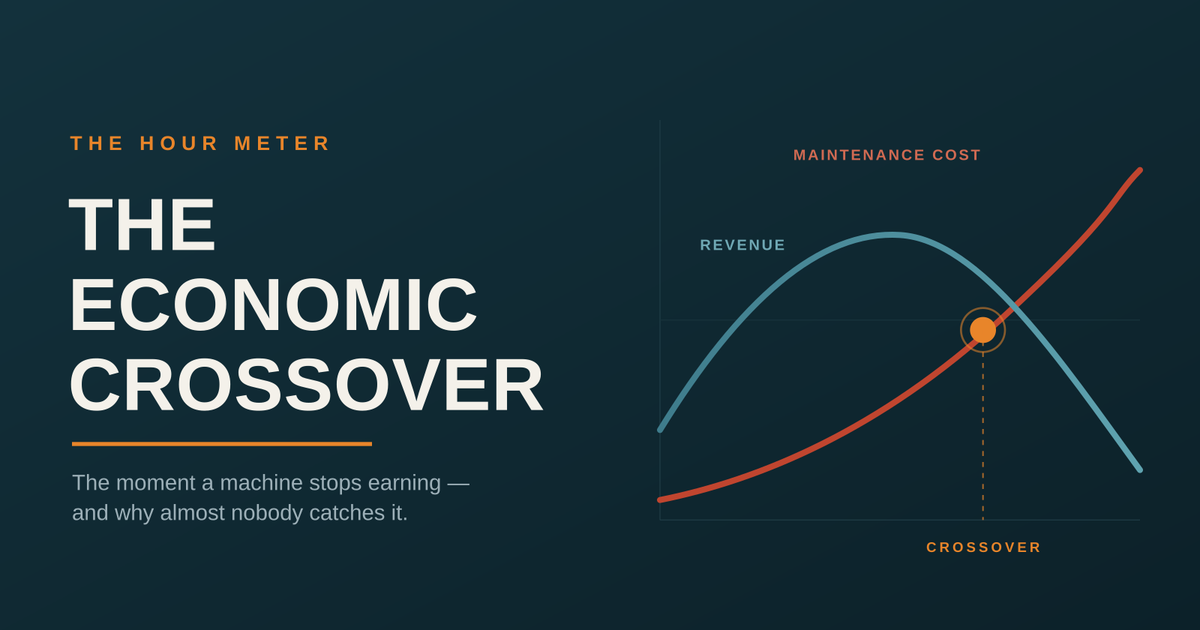
Every machine on your yard has a moment when it stops making you money. Almost nobody catches it on time.
In our industry, the real business isn’t buying equipment. It’s knowing exactly when each machine stops making you money.
A machine can run perfectly well and already be quietly destroying your EBITDA. The operator likes it. The workshop knows it. It looks fine on the yard. But on the P&L it crossed over months ago — and most fleets don’t have the data to see it until long after the fact.
I’ve watched this play out across multiple fleets, on two continents. The pattern is always the same, and it’s always missed for the same reason: we manage equipment as an operations problem when it is really a profitability problem.
Fleet management is a lifecycle discipline, not an operations function
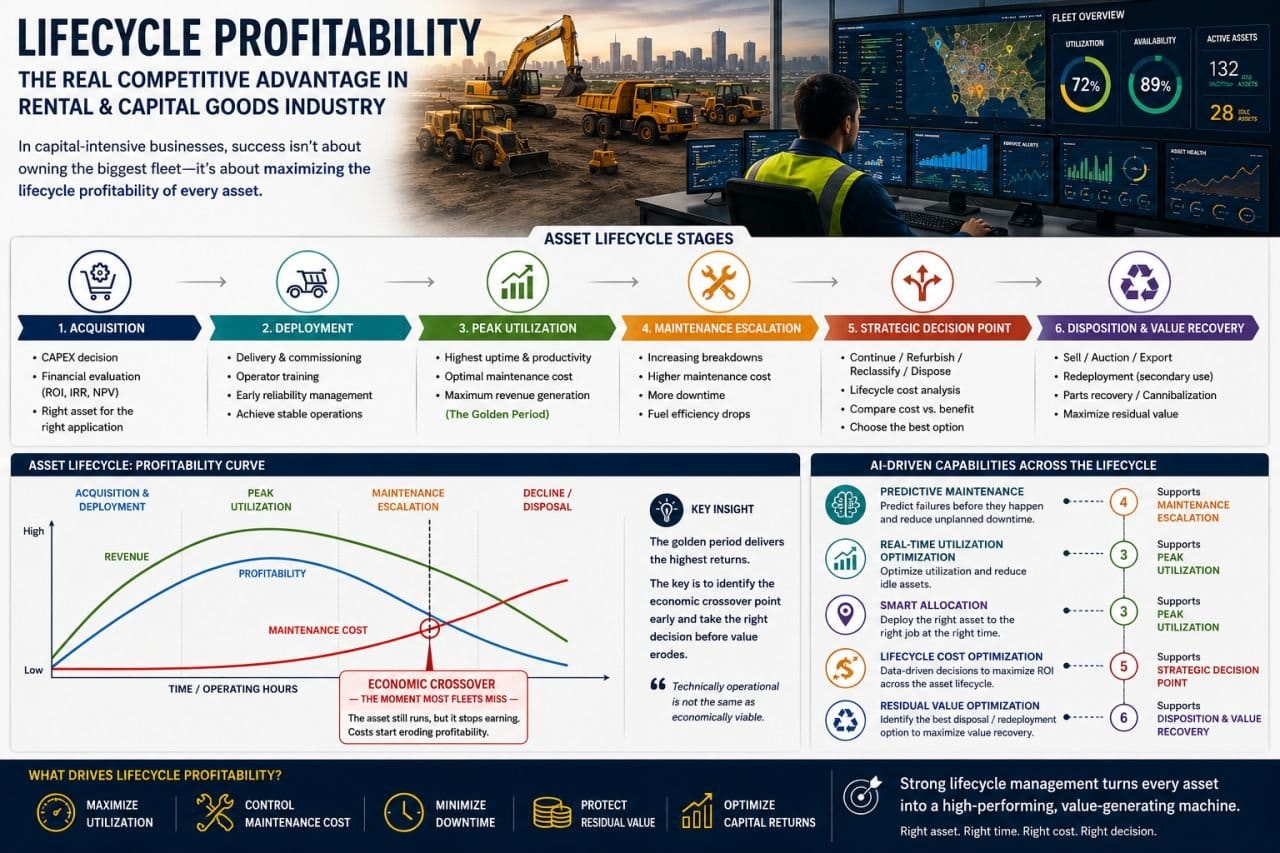
Every asset moves through the same arc. Acquisition. Deployment. Peak utilisation. Maintenance escalation. Then the decision: refurbish, redeploy, or dispose. The whole game is knowing where on that curve each unit actually sits today — not where you assumed it would sit when you signed the CAPEX note three years ago.
The trouble is that the curve is invisible from the yard. A machine doesn’t look less profitable. It looks like a machine. The decline shows up first in places nobody is watching in real time: maintenance creeping from scheduled to reactive, a breakdown that used to take half a day now taking two, fuel burn drifting up a few percent a quarter, and a residual value at year seven that the market simply won’t pay anymore.
None of those signals is dramatic on its own. Together, they are the sound of an asset sliding past the point where it earns its place in the fleet.
The golden period — and the moment it ends
There is a golden period in every asset’s life. Uptime is high. Maintenance is predictable. The machine is throwing off real margin, and it feels like it always will.
The job of leadership is to spot the moment that period ends. Not the moment the machine breaks down — the moment it stops being profitable. Those are two completely different points on the curve, and the gap between them is where fleets quietly bleed money.
This is the economic crossover: the point where the rising maintenance-and-downtime cost line crosses the falling revenue-and-residual line. After that intersection, the asset is still fully operational. It will start every morning. It will pass inspection. It is simply no longer economically viable — and every additional operating hour past that point is subsidised by the rest of your fleet.
Technically operational is not the same as economically viable. Most fleets never separate the two, because the systems they run on can only tell them the first one.
The same crossover sits in a different place in Mombasa than in Riyadh
Here is the part the global OEM playbooks gloss over: the crossover point is not a fixed engineering number. It moves with the economics of where the machine actually works.
I have run fleets in East Africa and I run them now in the Gulf, and the curve behaves differently in each. In East Africa, parts lead times are longer, financing is dearer, and the secondary market for used iron is deep and forgiving — which pushes the disposal decision later and makes refurbishment and cannibalisation genuinely economic. In the GCC, capital is cheaper and uptime expectations on a major contract are unforgiving, but the resale market for high-hour machines is thinner and the heat and dust accelerate wear in ways a temperate-climate maintenance schedule never accounts for — which pulls the crossover forward.
Same model of excavator. Same hour reading on the drum. Two completely different answers to the question “should this machine still be working?” An operator who treats the crossover as a universal number — or worse, as the manufacturer’s recommended replacement interval — will be wrong in both markets, just in opposite directions.
That is the discipline: reading the curve for your cost structure, in your market, on this unit. Not the brochure.
Where the new tools genuinely change the picture
I am normally sceptical of buzzwords, so take this for what it’s worth. Telematics, predictive maintenance, utilisation analytics, AI-assisted allocation — none of it is magic, and most of it is oversold.
But used properly, it gives you something we never used to have: an honest, real-time view of which assets are still earning their place and which ones are quietly draining cash. The hour meter on the dash was the first piece of telemetry a machine ever gave us — one number, read once a week, written in a logbook. What’s changed is that we can now read a thousand of those numbers continuously, across the whole fleet, and turn them into a live position on the curve instead of a guess.
Predictive maintenance attacks the cost line before a breakdown becomes a two-day event. Utilisation analytics and smart allocation push assets toward the right job at the right time, defending the golden period. And residual-value modelling, fed by real condition data rather than a depreciation schedule, finally lets you time the disposal decision to the market instead of the calendar.
The technology doesn’t make the decision. It just removes the excuse for not seeing the crossover coming.
The edge over the next few years
The competitive advantage in heavy equipment over the next few years will not go to whoever owns the biggest fleet. It will go to whoever manages their lifecycle the most intelligently — who maximises the golden period, controls the cost line, protects residual value, and has the discipline to dispose of an asset the moment it stops earning rather than the moment it stops running.
Strong lifecycle management turns every asset into a high-performing, value-generating machine. Right asset, right time, right cost, right decision.
So here is the question worth sitting with, whether you run ten machines or a thousand:
Do you actually know which of your units are past their economic crossover point right now — or are you still measuring them on uptime?
The Hour Meter is written from the operator’s side of heavy equipment — fleet economics, the rent-vs-own call, disposal and residual value, and where AI genuinely earns its keep. From Africa’s red dirt to the Gulf. Subscribe to get each piece as it’s published.